How to write a blog article
Turn a question your customers ask into a finished article. Learn how to brief a writer or an AI assistant, edit the first draft and get it ready to publish.
By Jan Stevens
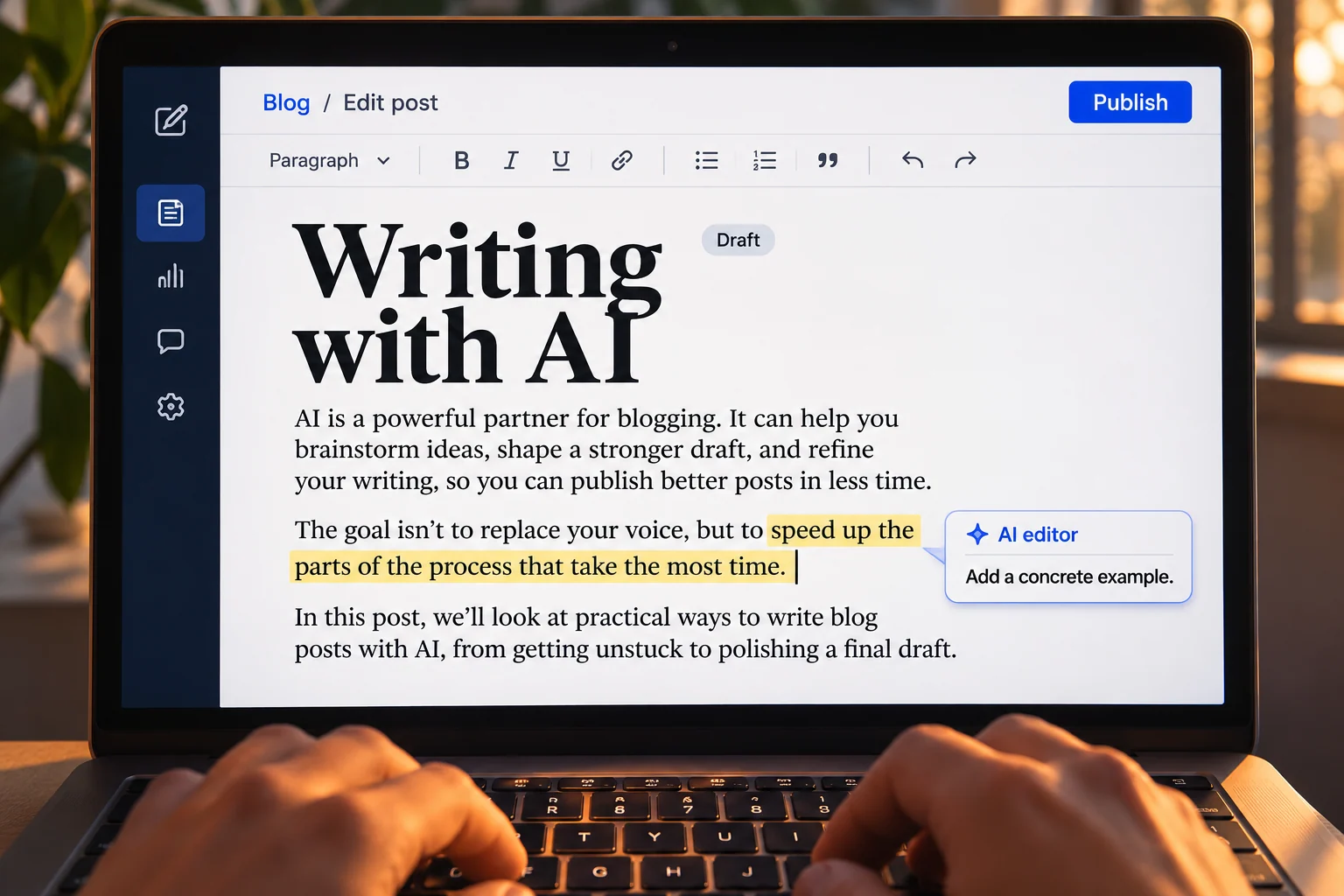
A useful blog article answers one question your customers actually ask, better than they could find elsewhere, and tells them what to do next. That is the whole job. Everything below is a way of doing it reliably, whether you write the piece yourself, hand it to a writer or start with an AI assistant.
The process has a handful of steps: pick the question, decide who it’s for, collect what only you know, plan, draft, edit and check, then publish and keep it current. To make it concrete, we’ll follow one imaginary business throughout: a small air-conditioning installer whose customers keep asking whether they should repair an old unit or replace it.
In this article
Start with a question someone has actually asked
The best topics are already in your inbox. Look through recent emails, WhatsApp messages and notes from phone calls, and write down the questions people ask before they buy, the ones they ask afterwards, and the misunderstandings you correct every week. Use their wording, not yours: customers ask “why is my air conditioner dripping water indoors?”, not “condensate management”.
Then narrow it down. “Everything about air conditioning” is a brochure, not an article. “Should I repair my old air conditioner or replace it?” is a question one person has, at one moment, with money on the line. A good test: can you give the answer in two sentences? If you can’t, the topic is too broad or you haven’t yet decided what you think.
Skip topics you’d only write to be seen to have a blog. Industry news that others cover faster, vague trend pieces and seasonal greetings rarely help a reader make a decision, so they rarely bring you work.
Decide who it’s for and what they should do next
Picture the person reading it. For our installer, it’s a homeowner in August with a unit that’s struggling, who doesn’t know refrigerant from a remote control and is worried about being sold something they don’t need. That tells you the tone (calm and straight), the level (no jargon without an explanation) and what they need from you (a way to decide, not a sales pitch).
Then choose one next step. It might be booking an inspection, checking the label on their unit, or simply understanding enough to ask the right questions when they get a quote. One step. An article that ends with five links and three offers usually ends with none of them taken.
Gather what only you know
This is the part that makes an article worth reading, and it’s the part neither a freelance writer nor an AI can supply. Anyone can produce a generic list of pros and cons. Only you know what actually happens on the job.
Give it fifteen minutes. Record a voice note or jot down answers to these: What do customers usually get wrong about this? What do you check first, and why? What does it typically cost, as a range, and what pushes the price up? How long does it take? When would you advise against your own service? What mistake do you see again and again? What’s specific to your area or the time of year?
Our installer might bring a repair quote and a replacement quote, with the customer details removed. Ask them to circle the figures they would compare and explain what would make them recommend the cheaper option. That explanation gives the writer something to work with.
Be honest in your notes, including the inconvenient parts. “It depends” is fine, as long as you say what it depends on.
Plan the article before you write it
A short outline saves more time than any writing trick. Note down a working title phrased the way the reader would ask the question; the answer in two or three sentences, which will become your opening; three to six sections, each answering one smaller question the reader will have; at least one concrete example; and the next step.
For the installer, that might be: the short answer; signs a repair is worth it; signs it isn’t; what each option costs and how long it takes; questions to ask whoever quotes you; what to do now.
Once the outline answers the question, stop adding sections. A reader can follow a short piece with a worked example more easily than a long one that keeps circling back to the same advice.
Write the draft, or have it drafted
If you’re writing it yourself, write quickly and edit later. Explaining the topic out loud, to a colleague or into your phone, and then writing down what you said usually beats staring at a blank page. Don’t spend an hour polishing the first paragraph; you’ll rewrite it anyway.
If you’re handing it to a writer or an AI assistant, the result depends almost entirely on the brief. Give them the question, the reader, your notes, the outline, the next step, a rough length and a sample of writing whose tone you like. Say what to avoid. A brief for our installer could read: “Write a 1,000-word article titled ‘Should I repair or replace my air conditioner?’ for homeowners in Alicante with an older unit. Use only the facts in my notes below; wherever you need a fact I haven’t given you, write [CHECK] instead of guessing. Open with the short answer. Plain UK English, no hype, no phrases like ‘in today’s world’. End by suggesting they book an inspection before the summer rush. Before you start, ask me anything you need to know.”
Those last instructions matter. Asking the assistant to question you first often brings out the detail that makes the piece useful. Asking it to write [CHECK] rather than guess protects you from its biggest weakness: AI tools are fluent and confident, and they will happily produce plausible prices, regulations and statistics that are simply wrong.
Used well, AI is good at turning rough notes into a structured draft, suggesting clearer headings, tightening long sentences and pointing out gaps in an argument. It’s poor at knowing your prices, your local rules or what really happens on a job, and left to itself it drifts towards the same smooth, interchangeable prose everyone else is publishing. Treat what it gives you as a first draft from a quick junior writer who has never met your customers.
For a busy owner, that makes a realistic split: fifteen minutes on notes, a few minutes on the brief, then half an hour reviewing and correcting. The review isn’t optional. It’s where the article becomes yours.
Cut the warm-up and sharpen the opening
Read the draft as the customer would, ideally out loud. You’ll hear where it drags, where it repeats itself and where it hedges.
Cut the warm-up. Imagine the first draft opens with “In today’s fast-paced world, choosing the right cooling solution can feel overwhelming.” You could delete that whole sentence and the reader would lose nothing. Now try “Ask for the repair and replacement quotes in writing and put them side by side. Does the repair quote cover the part that failed, labour and a second visit if you need one?” The reader has something they can do before they spend any money.
Next, replace vague words with specifics. “Affordable” becomes a price range. “Quickly” becomes “usually within a week, longer in July and August”. “High quality” becomes what you actually do differently. If you can’t make a claim specific, ask whether it needs to be there at all.
Make every heading say something. “Signs a repair is worth it” tells a skimming reader what follows; “Considerations” doesn’t. Many people will read only the headings and the first line under each, so those should carry the argument on their own.
Finally, check it sounds like you. If there’s a sentence you’d never say to a customer across the counter, rewrite it until you would.
Check every fact and promise
Go through the draft line by line and mark every number, price, timescale, rule, product claim and quotation. Check each one, or take it out. This applies just as much to what you wrote from memory as to anything a writer or an AI added.
Look closely at promises. If the draft says a new unit will halve a customer’s electricity bill, ask where that figure came from. When you have a documented comparison, explain what was measured and under what conditions. Otherwise, cut the figure.
If the article touches on legal, tax, health or safety matters, have someone qualified read those parts, or link to the official source rather than paraphrasing it.
Get it ready for the web
Title: use the words people would type or say, and make the promise clear. Clever titles rarely survive a page of search results. The question itself is often the best title.
Description: one sentence that tells the reader what they’ll get. It often appears beneath the title in search results and when the link is shared.
Layout: short paragraphs, descriptive headings, and lists only where the content really is a list. Most people will read it on a phone, so read it on one before you publish.
Links: link to the page where the reader can take the next step, and to one or two of your other articles if they genuinely help. Link to official sources for any rules you mention.
Images: use them when they explain something, such as a photo showing where to find the model label on a unit. Skip decorative stock photos. Give each image a short, plain description in its alt text so it works for people using screen readers.
Address: keep the URL short and readable, such as /repair-or-replace-air-conditioner, and if you ever change it, redirect the old one so existing links keep working.
Publish it, use it and keep it current
Publishing is the start, not the end. Send the link to the customer whose question prompted it. When the same question comes in again, answer it with the article: you explain things properly once and point people to it after that. Mention it in a newsletter or social post if you have one, and make sure everyone who talks to customers knows it exists.
Then put a reminder in your calendar to reread it in six months. Prices change, rules change and you’ll find better ways to explain things. Update the article and show when it was last revised, so readers know it’s current. A handful of accurate, well-kept articles is worth far more than dozens slowly going out of date.
Pay attention to what happens next. If people still ask the same follow-up question after reading it, the article is missing a section. Add it.
A checklist before you press publish
Read the finished page once as the person who asked the original question.
- Does the first paragraph answer the question?
- Is there something in it that only you could have written?
- Has every number, price and rule been checked?
- Do the headings make sense on their own?
- Would you say each sentence to a customer face to face?
- Is there one clear next step?
- Have you read it on a phone?
- Is there a date in your calendar to review it?

